Innovation Management Consulting
Specializing in Arduino, Robotics, and
Databases
Feldman Consulting Enterprises,
LLC

| Main | Arduino Consulting | Instrumentation Design | Wireless Networks | What Sets Us Apart | Background | About Us |
|
Feldman Consulting Enterprises, LLC offers a variety of Innovation Management Consulting Services, which will help to make your projects more successful. Our expertise and techniques in Innovation Management have been refined through application with many different companies on a wide array of innovation projects.
Is your company getting the maximum possible benefits from innovation? Does it seem like you need to do something to get ahead of the competition? Does your company have lots of ideas, but just can't seem to find the time and energy to forge ahead? Do you feel that you should be making more profit and revenue from projects you've worked on? Do you want your projects to be breakthroughs and "wow" the customer? Turn your ideas into profits! Innovation is necessary to stay ahead of the competition and improve margins and profitability. Many companies fail to innovate and focus too much on "today." What happens is "tomorrow" those companies are stuck with obsolete products, low margins, and they're struggling harder than ever to stay afloat. Don't get yourself caught in that trap! A healthy corporate environment is necessary for innovation. You need to take advantage of ideas that come along, choose the most appropriate ones to develop based on your capabilities and corporate strategy, and then devote the appropriate resources to making those projects as successful as possible. While every project entails some risk, if innovation is managed properly the costs of any failures will be more than outweighed by the benefits from your homeruns!
Here are some of the ways we can help:
Innovation Environment
Corporate Innovation Analysis We'll perform a complete analysis of the innovation process in your company by interviewing key employees and looking in depth at current and past innovation projects. This will help determine what your company is doing well in addition to identifying opportunities for improvement. This is designed to help your company:
Innovation Portfolio Planning
Innovation Portfolio Development and Strategic Innovation Analysis Your portfolio of innovation projects needs to be appropriately diversified in terms of risk and reward. A good portfolio consists of a mix of projects with both minor and major marketing and technological changes. The mix of projects should take into account your current offerings as well as those of your competitors to help you determine which projects will carry you into the future. This will ensure that your offerings stay competitive in the near term and in the long term, positioning your company to maintain or improve margins and expand into new markets by developing products and services which are unique in the marketplace.
Individual Innovation Projects
Marketing and Ethnographic Research Will your customers be rushing out to buy your latest product, or will it be a flop? Do you really know what your customers want? Are you trying to deliver something they don't really care about but missing the things that they aren't able to tell you that they need? By spending some time on the front end to investigate, the probability of success for your project will be much higher. Proven product development tools can make sure that you're putting your efforts in the right place and that your end result is going to be something that your customers enjoy.
Value Capture Planning Through careful analysis and planning strategies can be crafted to make sure that you reap the benefits from your innovation instead of copycats or your competitors. There are many great ideas out there, but there are things you can do to ensure that you're the one who profits from your hard work. We can help you by analyzing the markets that you want to introduce your innovation in, developing a business model, and assisting with determining appropriate pricing strategies.
Project Planning and Risk Mitigation While no innovative project can be guaranteed to be 100% successful, with proper planning at the beginning you can maximize the chances of success for your project.
Project Rescue Do you have a project that has gone off track or just never seems to get completed? Is the project over budget and behind schedule? Or is your project not generating the sales and profits for your company that it should be? We can do whatever is necessary to get your project back on track from analysis and recommendations to a complete takeover of the project to make things happen!
Funding Your Innovation Projects We have experience in assisting our clients find and successfully apply for grant money from various organizations to help pay for their innovative projects. While the return on investment of the projects we work on is often excellent, contributions from other sources to defray the expenses of the initial investment can make working with Feldman Consulting Enterprises, LLC even more attractive. We are a MATAAC Partner and have connections with several other funding sources as well. Not only do we want to help your business succeed, but there are others who want to help you succeed too!
Typical types of problems we've solved:
Ask yourself:
Did you answer "yes" to any of the above questions? We can help!
Here's how we've helped other clients with Innovation Management. You could be next!
Case One - A Better Way to Seal Ampules A local company desired to improve upon an ampule-sealing device that they were selling by developing the next generation of their product. By listening to their customers they knew what types of characteristics and features would be necessary to ensure that the redesign would be a success. The redesign involved improving the reliability and durability by replacing many mechanical components with electronics and sensors in conjunction with an Arduino robotics board and a custom-designed shield, which allowed for customer-requested adjustments to be made while using the device, such as speed and timing control. Any parts that were wear items were designed to be easily replaceable and many wear items were completely eliminated. Other attributes that were important to the customers such as noise and ease of adjustment were also addressed. In addition the modular design of the updated device allowed for flexibility in manufacturing and future product development. The building of subassemblies could be contracted out and assembly was simplified, reducing the amount of labor and lead times necessary to build the device. The system was also designed to accommodate add-on modules (which also use Arduino boards) so that it would be easy to expand the device to handle additional needs that customers had, including gas purging and liquid filling of ampules. Through clever engineering both add-on modules were designed to have commonality of over 80% of the parts, reducing development time and costs, and simplifying production. By developing these add-on modules the company was able to serve a segment of the market that previously was unable to automatically fill ampules, which made the device very popular among their customers. With the improvements and additional capabilities of the product line the company is also able to target new markets and applications, further increasing the potential for sales. Results:
See the Ampule Sealer in action!
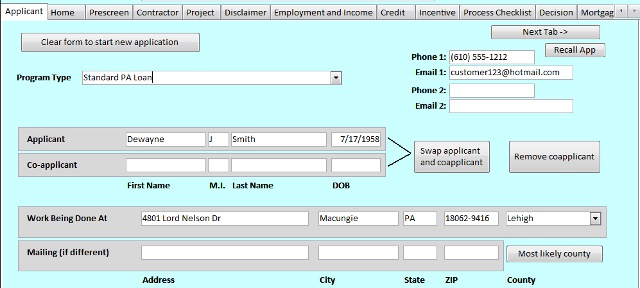
Case Two - Streamlining the Processes at a Financial Institution A financial institution that specialized in energy lending to consumers needed a loan origination system that allowed them the flexibility to track many unique parameters in order to properly administer different government programs with special requirements. Commercially available solutions were too rigid in their capabilities and weren't able to meet these needs. In addition those systems were very cumbersome to use and poorly integrated with the internal processes of the company, requiring lots of extra effort to manually process data from the loan applications. The company also had many data reporting requirements for the various programs that couldn't be met with what they had. A brand new database solution was designed to meet the needs of the company. The new database was designed to interface with many of the existing systems that the company used, from gathering loan applications from the website to pulling credit to creating and sending out the appropriate documents to customers and contractors. The database was developed in a modular fashion with scalability in mind so that future needs could be handled with a minimum of additional effort. The employees of the company were involved in every step of the development process to ensure that their needs were met and that the system would be well-accepted by the people using it on a daily basis. The solution allowed the company to drastically decrease the turnaround time and labor for processing loan applications while enabling them to easily analyze data for the programs that they were administering. The system had approximately 30 simultaneous users from various departments in the company, including management, accounting, sales, marketing, and underwriting. Results:
This is a typical input screen designed with user input and program-specific tabs along the top to automatically manage process flow, which reduces errors and makes training easier.
Many companies struggle with innovation. Yours doesn't have to be one of them. We can help you turn your ideas into profits!
Brian Feldman's answers to Innovation Management questions on Quora:
Your project could be a Breakthrough! Contact us today to find out how! Feldman Consulting Enterprises, LLC has worked with clients all over the world and is based out of Macungie, PA. Phone: 484-695-5651
(c) 2026 Feldman Consulting Enterprises, LLC |